
What Is an Embedded Engineering Team?
That's the textbook version. The honest version is that "embedded" has become one of the most stretched words in our industry. Plenty of providers use it for what is really a contractor in a separate Slack channel, working from a ticket list someone else wrote. So this guide spends less time on the definition and more on how to tell the real thing from the label, and on whether you need it at all.
Why companies end up looking for one
Nobody wakes up wanting an embedded team. They want the roadmap they promised their board, their customers or their own team. The search usually starts with one or more of these:
- A senior role open for so long that people stopped mentioning it in standup.
- A release date that has quietly moved twice.
- Engineers absorbing extra work until it starts to show in quality or morale.
- A new area, like platform, data or AI, that nobody on the team covers yet.
We'll say this even though we sell the alternative: for most core roles, hiring is still the right long-term answer. The problem is timing.
What embedded looks like when it's real
RULE OF THUMB
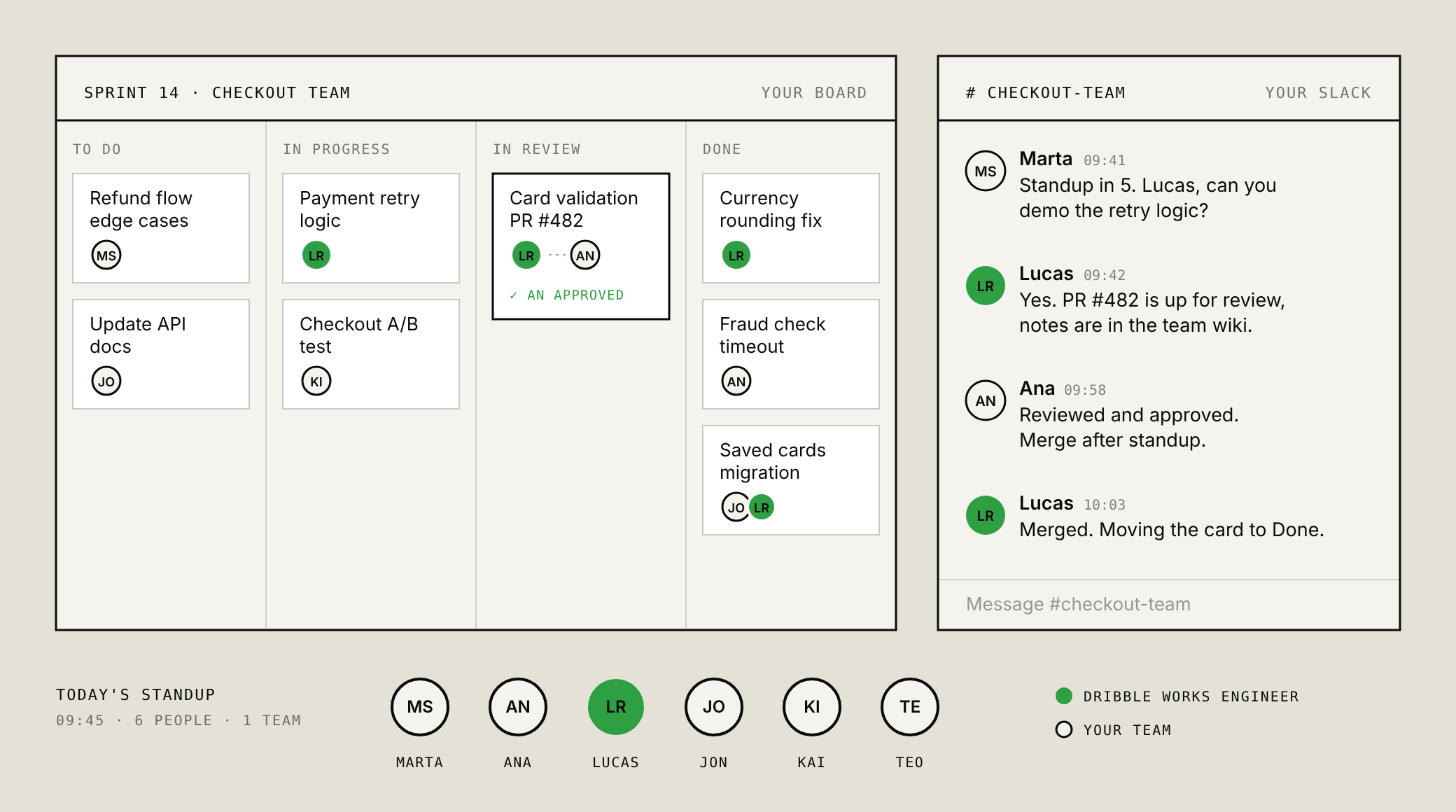
Sit in on a standup and try to tell who is external. In a well-run embedded setup, you can't.
In practice, that means:
- Same repositories and project board. Work is tracked where your team already tracks it.
- Same rituals. Standups, sprint planning, retros and code review include the embedded engineers.
- Same channels. Questions go in your team's Slack or Teams channels, where everyone can see them.
- Same standards. Your definition of done, review rules and documentation habits apply to them from week one.
- Same chain of priorities. Your product and engineering leads decide what gets built and in what order.
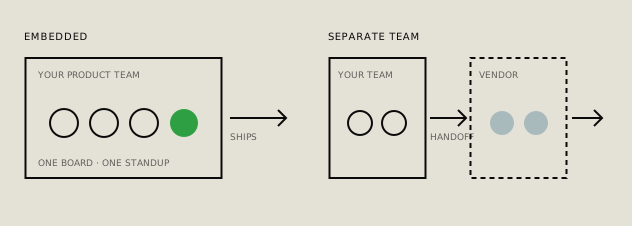
Organizational design research points in the same direction. The Team Topologies model talks about stream-aligned teams, teams aligned to a flow of work that own it end to end without handing it off. An embedded engineer strengthens one of those existing teams. A separate external team working next to yours would add a handoff instead.
OUR TAKE
If an external engineer needs a separate meeting to find out what your team decided, they're working next to your team, and that's a different arrangement. It can still be useful. Just make sure you know which one you're paying for.
How it compares with other ways to add engineers
- Versus outsourcing, the difference is mostly whose process the work runs through. We cover it in detail in embedded engineering team vs outsourcing.
- Versus staff augmentation, the difference looks small in a sales deck and very big around week three. By then, an embedded engineer is reviewing your team's code and owning an area, while a capacity hire is often still waiting for the next ticket. That's in embedded teams vs staff augmentation.
When we'd tell you to skip it
An embedded model needs an existing product team to embed into, and a bit of attention from your leads. Look elsewhere if:
- You need a one-off build and have no internal engineers to work alongside.
- You'd like an outside team to define your product direction for you.
- You're looking for firmware or hardware development. The word "embedded" means something very different there, as we explain in embedded engineering team vs embedded systems engineering.
- Your main criterion is the lowest hourly rate. Embedded models work best with senior engineers, and senior engineers cost more per hour than juniors.
- Nobody on your side can spare a couple of hours a week to give context. An embedded engineer without context is an expensive way to find that out.
How a Dribble Works embedded engagement starts
We run every engagement through the same sequence, the Dribble Embedded Delivery Framework: Diagnose → Match → Embed → Accelerate → Scale.
WHY WEEK ONE IS FOR READING
It's the step that raises the most eyebrows. Paying a senior engineer to read for a week feels slow when you're already behind. We think it's the cheapest week of the whole engagement, because it keeps the following eleven from going in the wrong direction. For the week-by-week detail, read how to integrate external engineers into your team.
How embedded engagements are usually priced
- Billed monthly, per engineer or per team.
- No recruiting fees.
- At Dribble Works, the first engagement runs for three months, roughly the time an engineer needs to integrate properly and show real output. After that, it renews month to month or by quarter.
When you compare that with hiring, compare the full picture:
Neither option wins every time. The useful comparison is cost against how soon the work gets done.
OUR TAKE
We'd rather lose a deal on price than win it by placing someone who needs supervision. A cheaper engineer who takes up your best people's time ends up costing more, even if it never shows up on an invoice.
How long embedded engagements last
There's no standard length. The common patterns:
- One crunch: a launch or a migration, finished after a quarter.
- Ongoing capacity: a year or more, because the roadmap keeps growing and the arrangement works.
- Start small, then grow: one engineer first, a small team once the value is obvious.
TIP
Start with one engineer, judge the fit honestly after the first month, and grow only once the value is obvious to your own engineers. Whatever the length, make sure the work stays useful after it ends: documentation in your systems and at least one person on your team who knows each area.
Five questions to answer before you bring in an embedded team
- Which area of the product will the embedded engineers own?
- Who on your side answers their questions during the first week?
- What should be different in 30 days for this to count as a success?
- Which systems will they need access to, and which can wait? (Our guide to giving external engineers access securely helps here.)
- Where will decisions and context be documented, so the knowledge stays when they leave? (See keeping the knowledge when external engineers leave.)
IF YOU ONLY ANSWER ONE
Answer the third. Teams that can describe what "better in 30 days" looks like get far more out of an embedded engineer than teams that only know they're behind. If some answers are still open, that's normal. It's what the first conversation is for.
If part of your roadmap is waiting on hires, take a look at how our embedded engineering teams work, or tell us what you need to ship. A senior person on our team reads every message and replies with a concrete next step.