
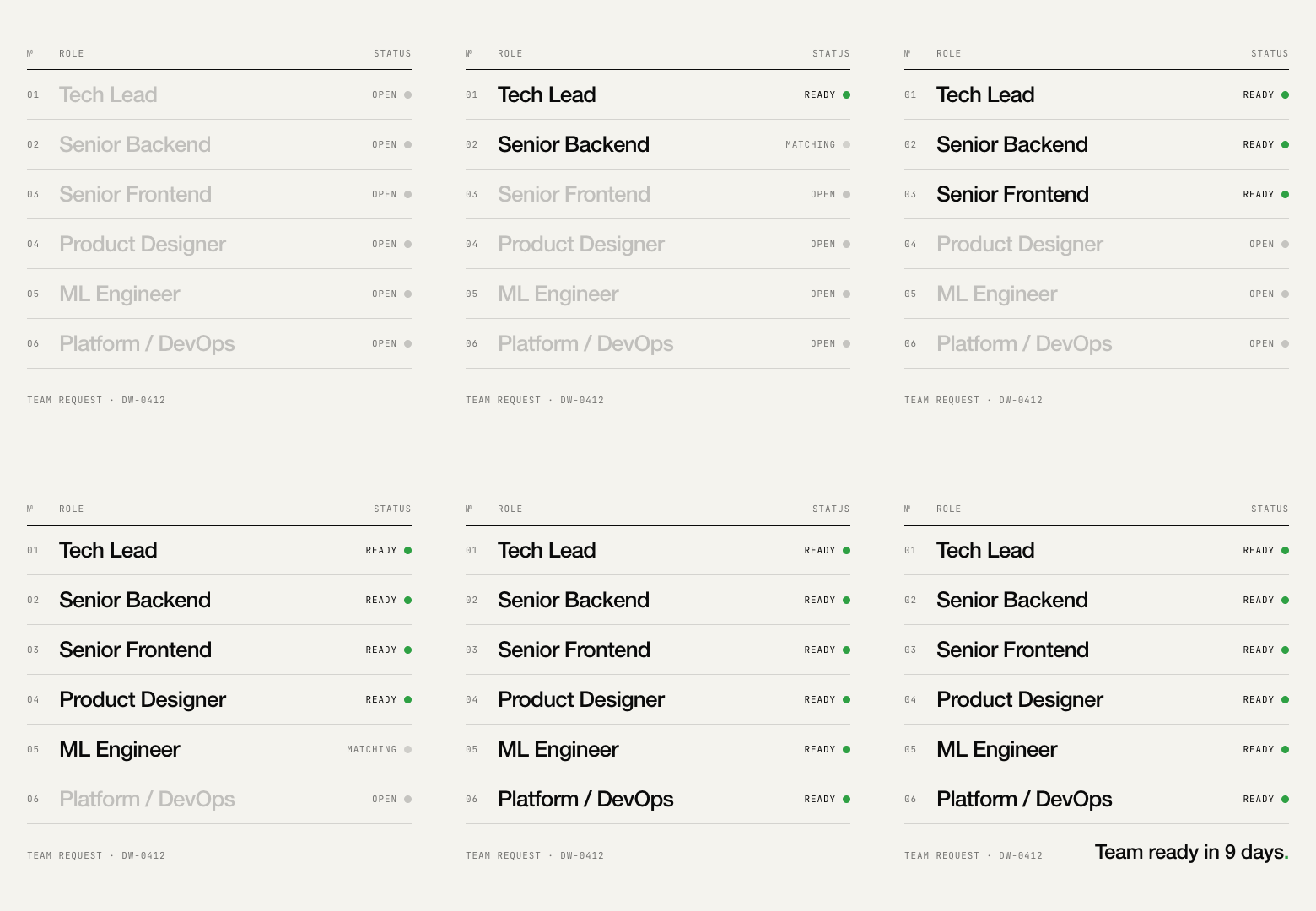
Inside your repos, standups and Slack, on the priorities your leads set.
Engineers in your sprint within weeks of your approval.
With one senior engineer for three months. Add more once the fit is proven.
Live overlap with European and US working hours.


You know what needs to be built. The trouble is that the roadmap is growing faster than the team that has to deliver it.
While the role stays open, releases slip, the engineers you have absorb the extra load and the features customers are waiting for sit in the backlog. For a funded company, every quarter of delay also spends runway that was raised against specific milestones.
SIGNS YOU'RE THERE:
We do our best work with a specific kind of team. If this sounds like yours, we should talk.
Plenty of providers call themselves an extension of your team. This is what it looks like day to day when we do it.

Your Repos, Your Boards, Your Sprints

Your Business, Your Product, Your Enigneering Leads.

Daily, in Your Tools, Your Slack, Your Standups.

You define what the team owns, and the outcomes.

All documentation done in your systems.

Build a long-term team, the same engineers month after month
Our engineers use AI every day for research, coding, testing and documentation, and they know when to double-check what it produces. Everything that reaches your codebase is reviewed and owned by a senior engineer, so you get the extra speed with the same standard of quality.
Most teams that hesitate to bring in outside engineers have done it before and spent weeks explaining the system to someone who then left. This is how we make sure that doesn't happen again.
A short call about your product, your roadmap, your stack and where delivery is getting stuck. We want to understand what kind of seniority you actually need before we suggest anyone.
We propose engineers for their experience, autonomy and communication as much as for their stack. You interview them and decide who joins.
Week one is for reading. The engineer goes through the repo history, recent postmortems, the CI config and the parts of the codebase everyone warns new people about. By the end of that week you get a written read of where delivery is losing time.
In week two, the engineer takes on something from your backlog that a senior engineer can own end to end, including review, tests and deploy. By week three they're reviewing your team's pull requests, which is usually where a stretched team feels relief first. From then on you get a short weekly update on what shipped, what's blocked and what's next.
Once the fit is proven, you decide what comes next: add engineers, change profiles, widen the scope or keep the capacity as it is.
Most teams start with a single senior engineer. It's the easiest way to see how we work inside your product before committing to more. From there, the engagement can grow with your roadmap.
One senior engineer to cover an open role or unblock a specific part of the roadmap
A small team of 2 to 3 engineers when one area of the product has to move faster, for example backend, frontend and QA automation
A pod of 3 to 5 with a tech lead when you need a whole front owned, like a new product line or a platform migration
Billing is monthly, with no recruiting fees. The first engagement runs for three months, which gives enough time for real integration and real output. After that, you renew month to month or by quarter.
Plenty of providers call themselves an extension of your team. This is what it looks like day to day when we do it.
An embedded engineering team is a group of external engineers who work inside your product team as if they were internal hires. They use your tools, join your standups, follow your engineering practices and report to your engineering leadership, so there's no separate vendor process running in parallel.
With outsourcing, you hand a defined scope to a vendor and they deliver it with their own team and process. An embedded engineering team joins your process instead. Your leads set priorities, the work happens in your repositories, and knowledge stays documented in your systems.
Traditional staff augmentation often focuses on filling capacity. Our embedded model adds an explicit expectation of ownership, autonomy and integration into delivery.
They adopt yours. Our engineers follow your branching strategy, code review rules, definition of done and documentation habits from the first week. If something in the process is slowing delivery down, they'll point it out in writing, and you decide whether to change it.
Less than a new hire. Your managers set priorities and include them in the team's rituals, but our engineers are senior enough to work without close supervision. Dribble Works also follows each engagement and sends a weekly update, so your managers aren't carrying the coordination alone.
They work through accounts your team creates and controls, with access limited to the area they're working on. We sign an NDA and data processing terms before anyone gets access, and when the engagement ends you remove access the same way you would for any internal departure.
It stays with you. Decisions, runbooks and context are documented in your systems as the work happens. Before an engineer rolls off, we plan the handover with your team so nothing depends on someone who's leaving.
No. Here, "embedded" describes how we work with your team. We embed senior software engineers into product teams building web platforms, SaaS, data and AI products. For firmware, microcontroller or hardware-level development, a specialist embedded systems firm will serve you better.
Describe what you're trying to ship and what's in the way.
A senior person on our team reads every message and gets back to you with a concrete next step.