
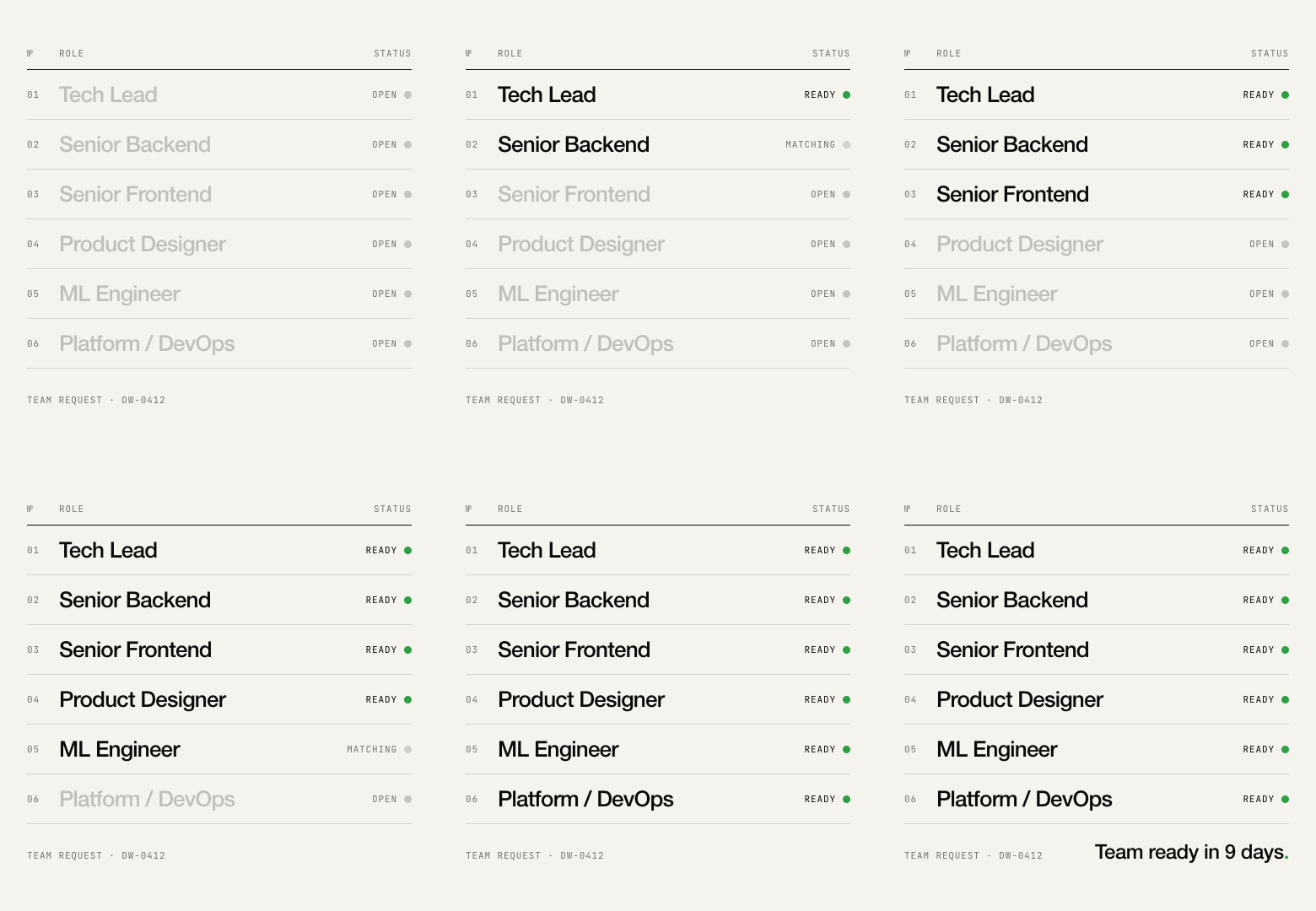
A team in your codebase within weeks. Hiring the same people takes months.
2 to 5 senior engineers, with a tech lead when the work needs one.
Your leads set priorities. We add delivery oversight and a weekly update.
One monthly fee for the team, with no recruiting fees.


Building a team in-house means job posts, interview loops, offers and notice periods, one person at a time. Meanwhile the launch date stays where it is and the engineers you already have cover the gap.
The cost shows up in places that are hard to recover: features customers are waiting for, enterprise deals that depend on them, and runway spent without the progress it was raised for.
A dedicated team gives you that capacity as a working unit while your hiring plan catches up.
We do our best work with a specific kind of team. If this sounds like yours, we should talk.
We put together the team your current challenge actually needs. A common setup is two or three senior engineers, for example backend, frontend and QA automation, or backend, DevOps and a tech lead.

The team works only with you, at your pace and on your priorities.

Your repos, your board and your standups. Your engineers and ours work as one team.

A new product line, a platform migration or a backlog that has to be cleared before launch. The team owns it and answers for it.

We track progress, risks and decisions so your CTO doesn't end up running a second team on the side.
Most teams that hesitate to bring in outside engineers have done it before and spent weeks explaining the system to someone who then left. This is how we make sure that doesn't happen again.
A short call about your product, your roadmap, your stack and where delivery is getting stuck. We want to understand what kind of seniority you actually need before we suggest anyone.
We propose engineers for their experience, autonomy and communication as much as for their stack. You interview them and decide who joins.
Week one is for reading. The engineer goes through the repo history, recent postmortems, the CI config and the parts of the codebase everyone warns new people about. By the end of that week you get a written read of where delivery is losing time.
In week two, the engineer takes on something from your backlog that a senior engineer can own end to end, including review, tests and deploy. By week three they're reviewing your team's pull requests, which is usually where a stretched team feels relief first. From then on you get a short weekly update on what shipped, what's blocked and what's next.
Once the fit is proven, you decide what comes next: add engineers, change profiles, widen the scope or keep the capacity as it is.
Most teams start with a single senior engineer. It's the easiest way to see how we work inside your product before committing to more. From there, the engagement can grow with your roadmap.
One senior engineer to cover an open role or unblock a specific part of the roadmap
A small team of 2 to 3 engineers when one area of the product has to move faster, for example backend, frontend and QA automation
A pod of 3 to 5 with a tech lead when you need a whole front owned, like a new product line or a platform migration
Billing is monthly, with no recruiting fees. The first engagement runs for three months, which gives enough time for real integration and real output. After that, you renew month to month or by quarter.
Plenty of providers call themselves an extension of your team. This is what it looks like day to day when we do it.
A dedicated development team is a group of engineers from an external partner who work full-time on one client's product. Unlike a project-based vendor, the team stays with you over time, follows your priorities and builds deep knowledge of your product and codebase.
You agree on the goal and the team composition, interview and approve the engineers, and pay a monthly fee for the team. The team works inside your processes and reports to your leadership. The partner handles hiring and payroll and, in our case, delivery oversight.
A development team turns product requirements into working software. Its role covers planning technical work, writing and reviewing code, testing, shipping releases and maintaining the product once it's live.
A dedicated team from Dribble Works takes on that same role inside your company, sharing ownership of delivery with your existing engineers.
To hire a dedicated development team, follow these steps:
1. Define the work.
2. Decide on seniority and team size.
3. Shortlist partners.
4. Interview the engineers.
5. Agree on scope, and communication.
6. Plan a clear onboarding.
With Dribble Works, it starts with the contact form. We then set up a call to understand your product and roadmap, and propose a senior team matched to your stack.
If you need to fill specific seats in an existing team, staff augmentation is usually enough. If you need a group of engineers to own a whole front, like a new product, a platform or a major migration, a dedicated team works better because it brings its own coordination and leadership.
For an evolving roadmap, usually yes. Fixed-price projects work when the scope is fully known in advance, but every change means renegotiating, and the vendor controls the process. A dedicated team adapts as your priorities change, and the knowledge it builds stays inside your company.
It depends on team size, profiles and specialization. We charge one monthly fee for the team, with no recruiting fees, and you see the full price in the proposal before anyone starts. A common starting point is two or three senior engineers, and you can start smaller and grow the team once you've seen how it works.
Typically a few weeks from the first conversation to the team working in your codebase. Hiring the same team in-house would usually take months, one role at a time.
At the start we agree what success looks like for the front the team owns: a release date, a migration milestone or a backlog target. Every week you get an update against it, covering what shipped, what's blocked and what's next. If progress stalls, you'll hear it from us before you have to ask.
Yes. The team can change as your roadmap does, whether that means adding an engineer for a launch or reducing the team once a front is done. We plan those changes with you so nothing gets lost in the transition.
You do. Everything the team builds belongs to your company. We sign an NDA and data processing terms before anyone gets access to your systems.
Describe what you're trying to ship and what's in the way.
A senior person on our team reads every message and gets back to you with a concrete next step.