
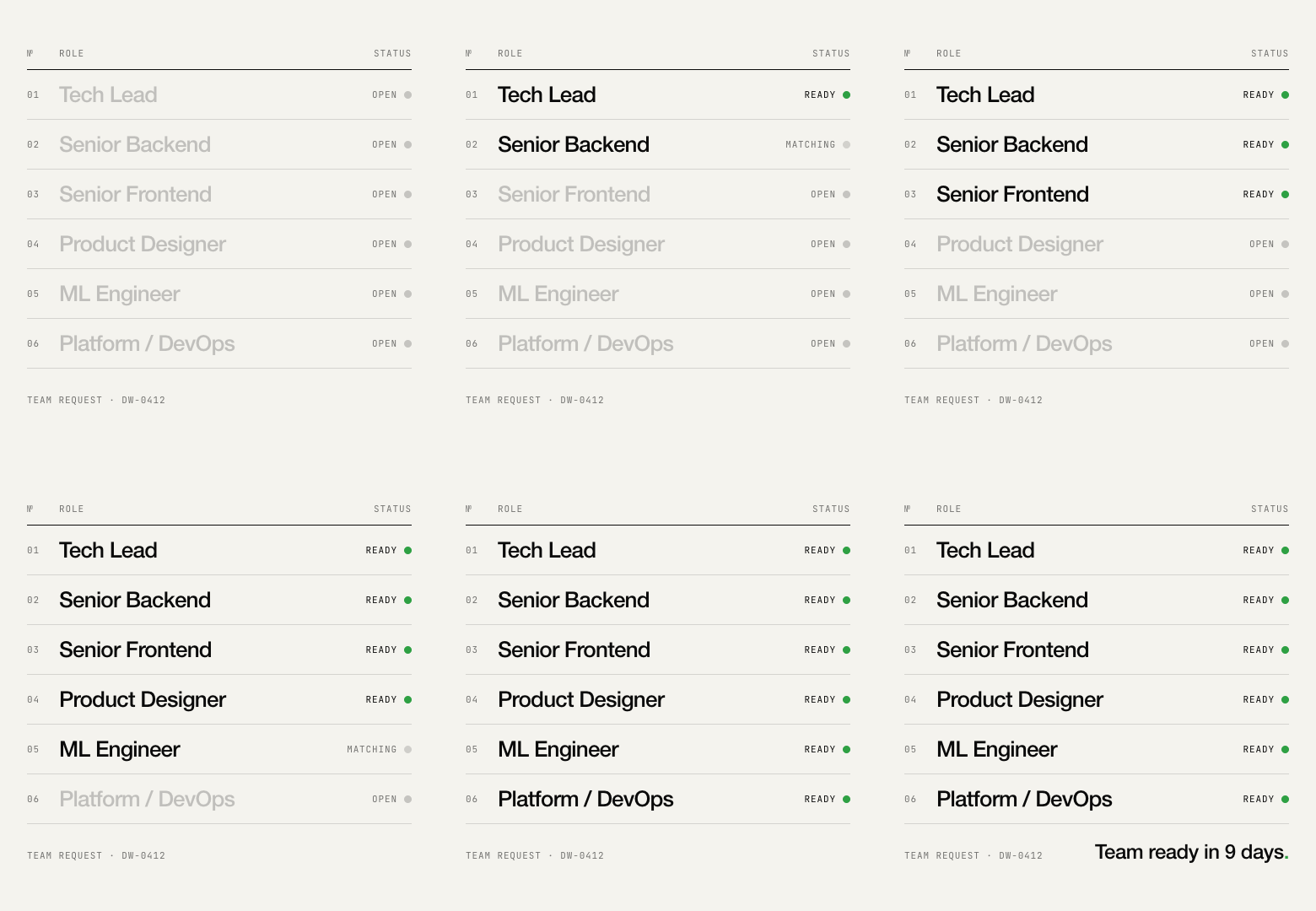
Engineers in your sprint within weeks of your approval.
Vetted for judgment, ownership and AI fluency as well as stack.
Yes. Nobody joins your team without your approval.
One engineer, three months, billed monthly.


Hiring a senior engineer takes time you rarely have. The best candidates have several offers, notice periods add weeks, and even a good hire needs time to ramp up.
Meanwhile your team covers the gap, releases move to the next quarter and the work that justified the role keeps waiting.
And if the hire turns out to be the wrong one, you start over.
What you need is a senior person working on the problem soon, with a way to check the fit before you commit long-term.
We do our best work with a specific kind of team. If this sounds like yours, we should talk.
Years of experience are only part of it. A senior engineer on your team should bring:

Making trade-offs you'd agree with, and explaining them.

Taking responsibility for part of the product as well as its tickets.

Raising risks early, in writing, before anyone asks.

Using AI to go faster and knowing when to verify what it produces.

Working without your CTO checking every pull request.

Leaving the codebase and the engineers around them better than they found them.
Our engineers use AI every day for research, coding, testing and documentation, and they know when to double-check what it produces. Everything that reaches your codebase is reviewed and owned by a senior engineer, so you get the extra speed with the same standard of quality.
You interview them yourself.
Nobody starts on your team without your approval.
Before an engineer joins a client, we look at:
Most teams that hesitate to bring in outside engineers have done it before and spent weeks explaining the system to someone who then left. This is how we make sure that doesn't happen again.
A short call about your product, your roadmap, your stack and where delivery is getting stuck. We want to understand what kind of seniority you actually need before we suggest anyone.
We propose engineers for their experience, autonomy and communication as much as for their stack. You interview them and decide who joins.
Week one is for reading. The engineer goes through the repo history, recent postmortems, the CI config and the parts of the codebase everyone warns new people about. By the end of that week you get a written read of where delivery is losing time.
In week two, the engineer takes on something from your backlog that a senior engineer can own end to end, including review, tests and deploy. By week three they're reviewing your team's pull requests, which is usually where a stretched team feels relief first. From then on you get a short weekly update on what shipped, what's blocked and what's next.
Once the fit is proven, you decide what comes next: add engineers, change profiles, widen the scope or keep the capacity as it is.
Most teams start with a single senior engineer. It's the easiest way to see how we work inside your product before committing to more. From there, the engagement can grow with your roadmap.
One senior engineer to cover an open role or unblock a specific part of the roadmap
A small team of 2 to 3 engineers when one area of the product has to move faster, for example backend, frontend and QA automation
A pod of 3 to 5 with a tech lead when you need a whole front owned, like a new product line or a platform migration
Billing is monthly, with no recruiting fees. The first engagement runs for three months, which gives enough time for real integration and real output. After that, you renew month to month or by quarter.
Plenty of providers call themselves an extension of your team. This is what it looks like day to day when we do it.
Hiring a senior software engineer in-house usually takes several months once you add sourcing, interviews, offer negotiation and notice periods, which can run one to three months in many European countries. Then comes ramp-up. Working with a partner like Dribble Works removes most of that wait: engineers can join your team within weeks.
Seniority is less about years and more about how someone works. A senior engineer makes sound trade-offs, takes ownership of outcomes, raises risks early and needs little supervision. In 2026, it also means using AI tools well and knowing how to verify what they produce.
In-house, the cost goes well beyond salary: recruiting fees, benefits, management time and months of reduced output while the role is open and the new hire ramps up. With Dribble Works you pay a monthly rate per engineer, with no recruiting fees, and you see the full price in the proposal before anyone starts.
Hire in-house for roles that are core to your long-term team and can wait for a full process. Use a partner when the need is urgent, when you need expertise your team doesn't have yet, or when you're not sure the role will be permanent. Many companies combine both.
We look at what they've actually owned in production, how they make decisions under pressure, how they communicate with product teams and how they use AI. Then you run your own interview. Nobody joins your team on the strength of a CV alone.
Yes. You meet every engineer before they join your team, and nobody starts without your approval.
They use AI for research, coding, testing and documentation, within your company's policies, and treat its output like any other code: reviewed, tested and owned by a senior engineer before it's merged. Your code review standards apply to them exactly as they apply to your team.
Yes. We operate from New York and Montevideo, with engineers based in Latin America who work in English. Their hours overlap with both European and US teams, so standups and reviews happen live.
No. We match senior engineers to your specific problem, stay accountable for how the engagement goes and support delivery the whole time. You work with us as a partner rather than sorting through profiles.
Describe what you're trying to ship and what's in the way.
A senior person on our team reads every message and gets back to you with a concrete next step.